

What’s the Hardest Thing About Being a Leader?

What’s the Hardest Thing About Being a Leader That Nobody Talks About? | Move Mountains

When we talk about leadership, we usually talk about strategy. We talk about vision, execution, and driving results. We discuss the mechanics of building teams and the metrics of organizational success.

But there is a quiet reality that exists behind closed office doors and in the spaces between meetings — a reality that most leaders experience but rarely discuss, out of fear that acknowledging it might make them look weak, uncertain, or unfit for the role they fought so hard to earn.

The hardest thing about being a leader isn’t making the difficult decisions. It is the profound, structural loneliness of carrying the weight of those decisions alone.

The Loneliness No One Warns You About

When you step into a senior leadership role, the air gets thinner. You are surrounded by people all day — direct reports, board members, investors, and clients — yet you can feel entirely isolated. This is not the ordinary loneliness of social disconnection. It is a structural isolation built into the role itself.

You cannot process a difficult termination with the team that reports to you. You cannot share strategic doubts with the board that is evaluating your performance. You cannot admit uncertainty to the investors who are counting on your confidence. You are expected to project clarity, even when you are navigating profound ambiguity. And so you perform. Every day. For everyone.

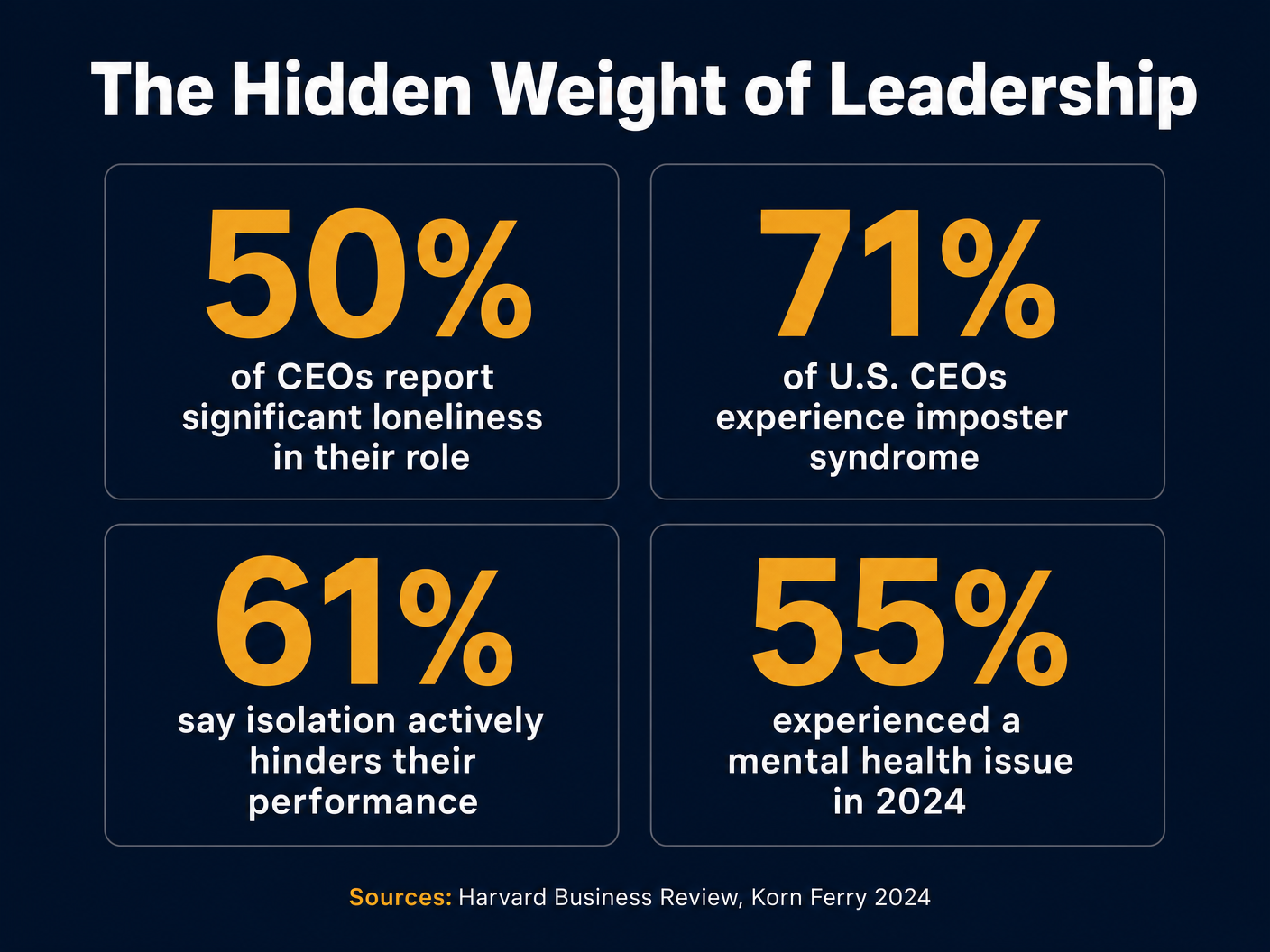
Even more striking: 72% of incoming CEOs report feeling lonelier after taking on new responsibilities, before they have had time to build trusted relationships. The promotion that was supposed to be the culmination of years of effort turns out to be one of the most isolating transitions a person can make.

A leader sitting alone at the head of a long conference table after a meeting, deep in thought

The structural loneliness of leadership is not about being alone. It is about being surrounded by people and still carrying the hardest things by yourself.

The Feedback Desert

One of the most disorienting transitions leaders describe is the sudden disappearance of honest feedback. For your entire career, you received performance reviews, peer critiques, mentorship, and real-time course corrections. The day you stepped into the top role, that stopped.

People do not tell the leader when they are wrong. Not directly. Not in real time. The power dynamic is too steep, and the political risk is too significant. What the leader receives instead is filtered information — data and perspectives shaped by what people believe the leader wants to hear, or what they believe is safe to say. Over time, this creates what I call a feedback desert: an environment where the person making the highest-stakes decisions has the least access to the unvarnished truth.

“The echo chamber effect develops not because leaders surround themselves with yes-men. It develops because the structure of the role makes honest dissent genuinely difficult for the people around them.”

— Charlie White, Founder of Move Mountains

Research from Harvard Business Review shows that over 70% of incoming CEOs report feeling lonelier after taking on new responsibilities, before they have had time to build trusted relationships. Decisions made without challenge calcify into blind spots. Assumptions go untested. The echo chamber effect does not develop because leaders intentionally surround themselves with people who agree — it develops because the structure of the role makes honest dissent genuinely difficult for the people around them.
The Imposter No One Sees

Most leaders were promoted because they were exceptional at something specific — driving product innovation, managing operations, building client relationships, or executing a financial strategy. They were rewarded for depth of expertise in a domain they had spent years developing. Then they became the leader, and all of that expertise became largely secondary to the demands of the new role.

Leadership requires a fundamental shift: from doing to enabling, from expertise to judgment, from managing a function to holding an entire organization’s direction. It requires making consequential decisions under conditions of incomplete information, where the cost of being wrong is not a missed target but a company-altering crisis.

This gap between what you were trained to do and what you are now required to do breeds a silent epidemic of self-doubt. And the most dangerous part? The higher you rise, the less acceptable it feels to admit it. So the doubt goes underground, where it quietly shapes decisions, erodes confidence, and widens the gap between who you appear to be and who you feel you actually are.

A leader standing in front of a mirror in a modern office, the reflection conveying the duality of public confidence versus private self-doubt

Imposter syndrome in leadership is not about incompetence. It is about the gap between the role you were trained for and the one you are now asked to fill.

The Antidote: Dropping the Mask

At Move Mountains, we see this pattern constantly. Leaders who know better but cannot seem to do better under pressure. Good people burning out — not from the work itself, but from the emotional labor of maintaining the performance of invulnerability. The weight of carrying everyone else’s uncertainty while suppressing their own.

The instinct when feeling isolated or uncertain is to grip the wheel tighter, project more certainty, and build thicker armor. But the actual solution is the exact opposite.

The antidote to leadership isolation is vulnerability. Not the oversharing kind. Not the kind that erodes authority or floods your team with your anxiety. Strategic, intentional vulnerability — the willingness to be honest about process, to acknowledge difficulty, and to invite others into the real conversation rather than the performed one.

Two professionals engaged in an open, honest conversation in a sunlit modern office, conveying trust and psychological safety

Psychological safety begins the moment a leader is willing to say, “I don’t have all the answers” — and mean it.

When a leader is willing to say “I made a mistake” or “I’m not sure yet,” it does not diminish their authority. It humanizes them. It gives the team permission to also be human — to take risks, to surface problems early, and to speak the truth rather than the safe version of it. As Brené Brown puts it: vulnerability is not weakness. It is power.
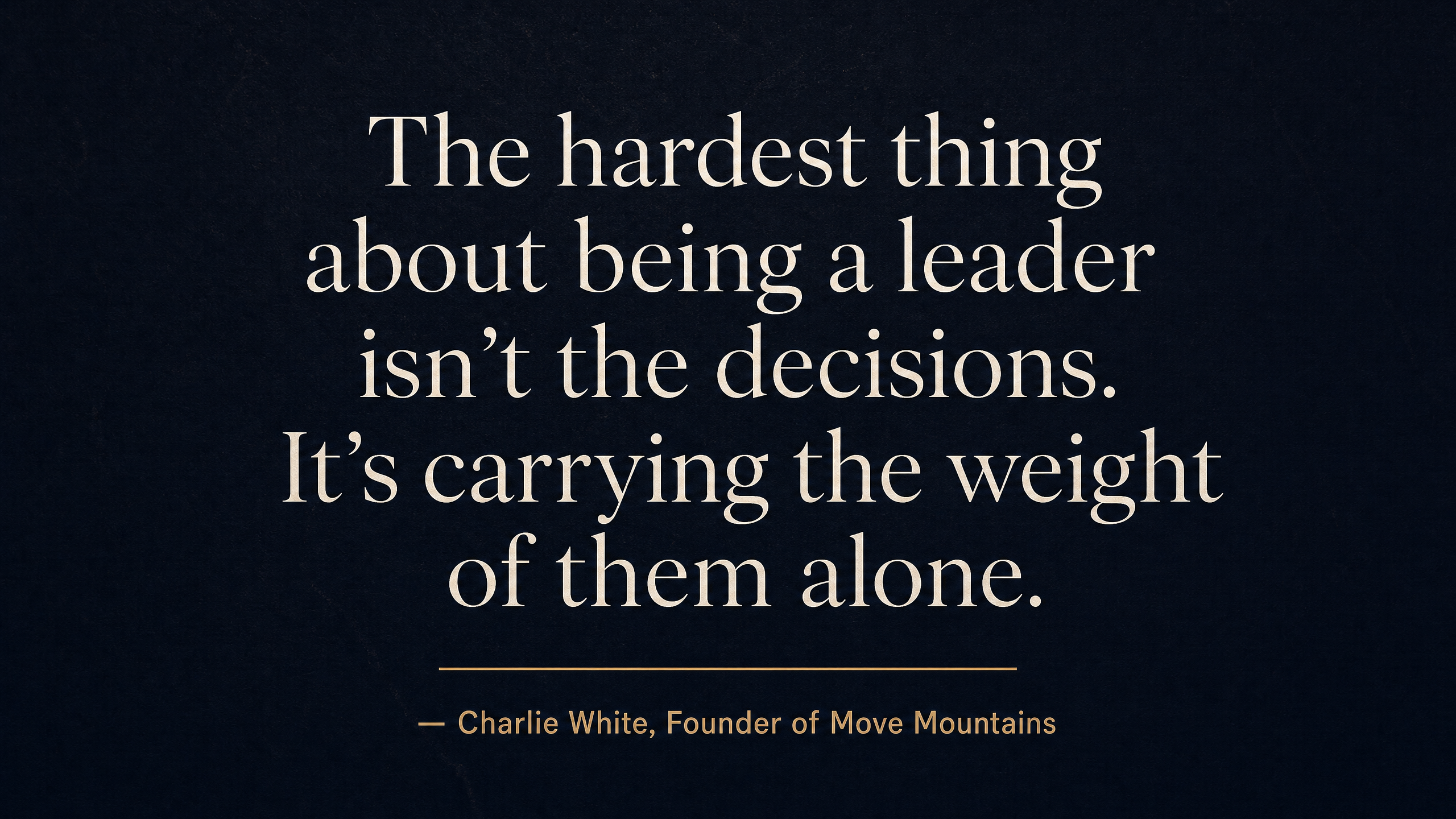
Pull quote: The hardest thing about being a leader isn't the decisions. It's carrying the weight of them alone. — Charlie White, Founder of Move Mountains
Actionable Takeaways

Knowing what to do differently is the easy part. Here is where to start.

1

Build a Personal Board of Directors

You need a confidential space where you do not have to perform. Cultivate a small group of peers, mentors, or an executive coach who have no financial or political stake in your company. These are the people who will tell you the truth and allow you to process uncertainty out loud — without it becoming organizational noise.

2

Actively Solicit Dissent

Stop asking “Does everyone agree?” and start asking “What am I missing?” or “Who sees this differently?” When you reward the people who are brave enough to push back, you dismantle the feedback desert one honest conversation at a time. Make it structurally safe to disagree, and people will.

3

Practice Strategic Vulnerability

You do not need to overshare to be vulnerable. Strategic vulnerability means being transparent about the process, acknowledging the difficulty of a situation, and admitting when you do not have all the data. It is the difference between saying “Everything is fine” and saying “This is a challenging quarter, but here is how we are navigating it together.” One builds compliance. The other builds trust.

4

Name the Loneliness — At Least to Yourself

Awareness is the first act of leadership. If you have been feeling the weight of isolation and have been calling it something else — stress, fatigue, burnout — try naming it accurately. Loneliness is not a personal failure. It is a structural feature of the role. When you name it honestly, you can begin to address it intentionally rather than just endure it.


Leadership will always carry weight. The decisions are real, the stakes are high, and the responsibility is significant. That does not change. But the way you carry that weight — alone and armored, or connected and grounded — makes all the difference. Not just for you, but for every person who is watching how you lead.

The body learns what the mind cannot teach. And the experience of leading authentically — without the heavy armor of performed perfection — is a transformation that changes not just the leader, but the entire organization around them.

Work With Move Mountains

Ready to Lead Without the Armor?

We work with leaders who are ready to do the hard part — not just understand differently, but show up differently. Let’s start with a conversation.

Schedule a Discovery Call
Charlie White
Founder, Move Mountains

Charlie White is the founder of Move Mountains, a leadership development firm based in Incline Village, Nevada, that works with leaders, teams, and organizations to install real, lasting behavior change. Through coaching, training, adventure experiences, and speaking, Move Mountains helps leaders access their best — especially when it matters most.

Sources

  1. Harvard Business Review. “CEO Loneliness and Leadership Struggles.” Research on executive isolation and performance impact.
  2. Korn Ferry. “71% of U.S. CEOs Experience Imposter Syndrome.” Survey of approximately 400 U.S. executives, June 2024.
  3. Gallup. “The Power of Leading with Vulnerability.” Research on employee engagement and leader authenticity.
  4. Gallup. “Why Trust in Leaders Is Faltering and How to Gain It Back.” April 2023.
  5. Journal of Occupational Health Psychology. Research on clinical depression rates among executives versus general workforce.

Share

What separates great leaders from average ones isn’t intelligence, credentials, or experience. It’s the standard they set and the culture they build around it.

I sat down recently with Dr. John Holmes, COO of STAX Engineering and a retired U.S. Coast Guard Captain with over 40 years of maritime leadership experience. The conversation pushed on a few things I needed to look at in my own practice.

Dr. John Holmes COO STAX Engineering retired U.S. Coast Guard Captain

Who Is Dr. John Holmes?

John isn’t a typical COO. Before leading operations at STAX — a company whose mobile technology captures and controls ship emissions without modifying the vessel — he spent decades commanding U.S. Coast Guard units in demanding operational environments.

Now he applies those same principles to a fast-scaling company that’s an approved provider of on-call emissions control services for vessels at the Port of Los Angeles.

40+ Years
Of maritime leadership experience brought into private-sector operations

Active barges, volatile port schedules, regulatory complexity, a young and diverse workforce — STAX is a real-time leadership laboratory. Sitting across from John, you can feel the experience behind every answer.

The “Good Enough” Trap

One of the moments that stuck with me was John talking about his own early years. He coasted through high school and the first half of college on “good enough” effort, then finished his last two years with a 4.0 once he understood what full commitment actually meant.

“Good enough just isn’t. You can’t dial it in.”

I want to be careful with this one, because it’s not about perfectionism or never feeling like you’re enough. There’s a difference between beating yourself up and showing up with your full capacity, whatever that looks like on a given day.

What John is pointing at is intentionality. When leaders and teams settle for 70%, they don’t just underperform — they erode the culture around them without realizing it.

A simple question for any leader: are your standards explicit? Do your people actually know what “great” looks like on your team?

Alignment Over Agreement

The most useful insight from John’s career, for me, was this: in the military, once you walk out of the room, everyone pulls in the same direction — whether they agreed inside it or not.

In the civilian world, he found the opposite. Decisions get relitigated. People lobby for do-overs. Energy bleeds out through the hallways.

“You can make a bad decision work if everybody’s pulling in the same direction. But if you’re not pulling together, you can’t even make a good decision work.”

That landed for me. The breakdown is rarely the strategy. It’s the lack of unified commitment to executing it.

I see this constantly. Leaders spend enormous energy crafting the right plan, then watch it fail — not because the plan was wrong, but because two or three people half-delivered their piece.

What John and I landed on is straightforward: debate hard before the decision, commit fully after, evaluate at a defined checkpoint, then adjust. Agility and alignment work in sequence, not opposition.

Servant Leadership in Practice

John is direct about the philosophy underneath his leadership: servant leadership. Not the version on office walls — the actual practice of having your people’s backs, taking the hit when something goes wrong, and building people up so they can carry more.

He said something worth repeating: people don’t care what you know until they know that you care. At STAX, that shows up in real ways — flexibility when life demands it, ownership in the mission, and expectations that communicate belief instead of pressure.

This is the difference between team development and team building. Topgolf every quarter is fine. But it doesn’t build the trust and shared accountability that hold a team together when something hard happens.

Leadership team alignment trust and servant leadership in practice

What You Can Use

Here’s what I’d take from the conversation:

  • Audit your decision culture. Honest debate before the decision. Full commitment after. A defined review window so people trust that committed doesn’t mean permanent.
  • Hire for fit, not just credentials. Look for people who’ll work with the company, not just for it.
  • Set high expectations as an act of belief. Excellence communicates trust when it’s paired with support.
  • Give people equity in the outcome. Literal or cultural — people perform differently when they have ownership.
  • Know the difference between team building and team development. Social connection builds rapport. Intentional growth builds performance.
  • Model “I was wrong.” Leaders who own mistakes create teams willing to take risks, tell the truth, and learn fast.

Before the Decision

Invite honest debate, challenge assumptions, and surface concerns while the door is still open.

After the Decision

Require unified execution. Alignment matters more than lingering private disagreement.

At the Checkpoint

Review outcomes together, learn quickly, and adjust without blame.

The Bottom Line

Conversations like this are why I do this work. The principles forged in some of the most demanding leadership environments — the open ocean, search and rescue, national security — translate directly to a boardroom, a startup, a scaling company.

The thread running through everything John shared is the same thread we work with at Move Mountains. Set the standard. Align the team. Serve the people in front of you. Refuse to settle for good enough.

That’s how leaders move people forward.

Ready to build a leadership culture that actually moves people forward?

Dr. John Holmes was a recent guest on the Move Mountains Podcast. Listen wherever you get your podcasts. If you’re working on alignment, accountability, or culture inside your organization, reach out.

Connect With Move Mountains

About the Author

Charlie White is a leadership coach and facilitator with Move Mountains, where he helps leaders and teams grow through mindful leadership, experiential learning, and intentional team development. His work centers on helping organizations build healthier cultures, stronger relationships, and more aligned execution.

Sources:

STAX Engineering team page: https://www.staxengineering.com/our-team/

STAX Engineering Port of Los Angeles announcement: https://www.staxengineering.com/stax-hub/stax-pola-contract-release/

Move Mountains Charlie White bio: https://www.movemountains.com/about-us/our-team/charlie-white

Share

You’ve been in that room. Everyone’s energized. The facilitator is sharp. The content is genuinely good. Leaders are nodding, taking notes, maybe even having small breakthroughs.

And then Monday morning arrives. The inbox fills back up, the pressure returns — and within a few weeks, almost nothing has changed about how people actually lead.

That’s not a people problem. That’s a brain problem. And once you understand what’s actually happening neurologically, you can’t unsee it.

80–90% of new skills learned in a single training are forgotten within 30 days when there is no structured reinforcement.
— Ebbinghaus Forgetting Curve, widely replicated in organizational learning research

The forgetting curve isn’t new. German psychologist Hermann Ebbinghaus documented it in the 1880s — and over 130 years of research has only confirmed it. Without reinforcement, memory retention drops sharply in the first 24 hours, and continues falling until roughly 80–90% of the content has faded within a month.

The leadership development industry has known this for decades. And yet most programs are still built as one-and-done events.

This article breaks down why that’s happening at the neurological level — and what leadership development actually needs to look like to produce real, lasting behavior change.

The Real Reason Training Doesn’t Stick

Most leadership programs are designed around a well-intentioned but scientifically flawed assumption: that if you give people the right knowledge and the right frameworks, their behavior will follow.

It doesn’t. And here’s why.

Research by behavioral scientist Daniel Kahneman shows that approximately 96% of human behavior is automatic and situational — driven by fast, unconscious mental patterns rather than deliberate, rational thinking. The slow, conscious brain we rely on during a training session represents only about 4% of our decision-making in a real day.

When a manager returns to work and faces a tense team meeting, a frustrated direct report, or a high-stakes conversation — their nervous system takes over, not their notes from the workshop. Old neural pathways, built through years of habit and environment, fire before conscious thought kicks in.

“Lasting behavioral change requires rewiring neural pathways through repetition and practice over time. A single workshop, no matter how engaging, simply cannot create the neurological changes needed for sustained leadership improvement.”

This isn’t a character flaw in the leaders. It’s physics. The brain is extraordinarily efficient at running on autopilot — and any new behavior that hasn’t been practiced enough to become a habit will simply lose to the existing neural pattern under pressure.

Glowing neural pathways in the human brain — neuroscience of leadership behavior change

Lasting leadership change happens at the neurological level — not just the intellectual one.

What the Neuroscience Actually Tells Us

The good news: the brain is not fixed. Neuroplasticity — the brain’s ability to form and strengthen new neural connections — means real change is always possible. But it requires specific conditions that most leadership programs never create.

Here’s what the research says is actually required:

  • Repetition over time, not intensity in a moment. A single powerful workshop creates exposure, not habit. New neural pathways are formed and strengthened through repeated, spaced practice — not a three-day intensive followed by silence.
  • Application in real context. Skills practiced in a training room under low stakes don’t automatically transfer to high-stakes moments. Leaders need opportunities to apply new behaviors in actual work — and to get feedback on what happened.
  • Emotional engagement. The brain encodes memories more deeply when they’re connected to genuine emotion, meaning, and physical experience. Purely cognitive training — slides, frameworks, lectures — doesn’t create the same neurological imprint as embodied, experiential learning.
  • Environmental reinforcement. Research by Knowles and colleagues found that behavior change following a one-off training had disappeared in more than 85% of cases after six months — because the environment the leaders returned to hadn’t changed. Systems, norms, and structures either reinforce new behaviors or undermine them.

Put simply: knowledge doesn’t change behavior. Behavior changes behavior. And that requires a fundamentally different approach to leadership development.

The Move Mountains Approach: Be. See. Send.

Leaders in outdoor conversation in the forest — Move Mountains adventure leadership retreat

Real conversations in real environments. Move Mountains weaves leadership development into lived experience.

At Move Mountains, our entire approach is built around what neuroscience actually requires for lasting behavior change. We don’t run workshops and walk away. We stay — working with leaders and teams over 6 to 24 months — because that’s what it takes to turn new awareness into new behavior.

At the center of everything we do is a framework called the Mindful Leadership Map — a simple, repeatable operating system for leaders that works precisely because it’s designed to be practiced, not just learned.

BE Get Present Ground your attention — physically, intellectually, emotionally, and spiritually — before you respond. SEE Get Clear Connect to your North Star. How do you actually want to show up in this moment? SEND Get Moving Choose a response that serves both the relationship and the mission — and stay with it.

Be. See. Send. isn’t three tools you pull off a shelf when things are calm. It’s a practiced way of operating — one that becomes available to you under pressure only because you’ve built it into your neurology through consistent repetition.

That’s also why we weave adventure experiences into our programs. The Sierra Nevada backcountry — three days without cell service, real physical challenge, real stakes — creates the emotional and embodied conditions that classroom training simply cannot replicate. Leaders discover things about how they actually operate under pressure when the trail is steep and the comfort is gone. And those discoveries stick.

What Leadership Development Should Actually Look Like

If you’re evaluating your organization’s approach to leadership development — or making the case internally for something that goes deeper than a workshop — here are the questions worth asking:

  • Does it reinforce over time? Look for programs that build in spaced practice, coaching, and check-ins across months — not a single event.
  • Does it create conditions for real practice? Leaders need to apply new behaviors in actual work, receive feedback, and then try again. Not role-play it once in a training room.
  • Does it engage the whole person? Purely intellectual training engages about 4% of what actually drives behavior. Effective programs engage body, emotion, and meaning — not just the rational mind.
  • Does it measure behavior change? Not satisfaction scores or post-training surveys. Actual changes in how leaders show up, how teams communicate, and what the culture feels like.
  • Does it address the environment? Individual behavior change rarely survives in an unchanged environment. The best programs also look at systems, structures, and norms.

The gap between knowing what to do and actually doing it under pressure — that’s the gap we close. Not with a better binder or a more engaging presenter. With sustained engagement, embodied practice, and a framework leaders can return to in any moment.

Ready for leadership development that actually lasts?

Explore our coaching programs, adventure retreats, and team training offerings designed around how the brain actually changes.

Explore Our Programs →

About the Author

Brian Williams is the Director of Business Development at Move Mountains and a keynote speaker whose flagship talk, Where Kindness Becomes Culture, connects belonging, psychological safety, and kindness to measurable business outcomes. He works with organizations across industries to help leaders build cultures where people can do their best work.

movemountains.com

Share

If your company is struggling with turnover, miscommunication, low trust, or leaders who know better but can’t seem to do better under pressure, the issue may not be strategy. It may be relationships. That matters because relationships shape how work gets done, how conflict gets handled, and whether your people bring their best when it matters most.

Emotional intelligence is often treated like a soft skill. In practice, it behaves more like a performance multiplier. TalentSmart’s business-case research found that EQ explains 58% of job performance, and 90% of top performers score high in emotional intelligence. In other words, the ability to regulate emotion, read a room, handle tension, and communicate clearly is not separate from performance. It is part of performance.

This shows up in the numbers. In a multinational consulting firm, senior partners with high emotional intelligence generated $1.2 million more profit each than low-EQ partners. In another case cited by TalentSmart, sales staff at Hallmark Communities who developed emotional intelligence were 25% more productive than their low-EQ counterparts. When leaders build trust, stay grounded under pressure, and give feedback without triggering defensiveness, teams move faster and waste less energy on friction.

The payoff also shows up in retention and engagement. Research summarized in a recent workplace analysis found that teams led by managers with high emotional intelligence experienced 20% lower turnover and 40% higher engagement scores. That matters because replacing people is expensive, but losing trust is even more expensive. Once a team starts bracing against its leaders instead of collaborating with them, performance drags everywhere: meetings, decisions, customer interactions, and culture.

This is why relationship ROI deserves boardroom attention. Emotional intelligence improves how leaders listen, how peers navigate conflict, and how teams recover when things get hard. It helps people respond instead of react. It turns feedback into growth, tension into clarity, and communication into a real operating advantage.

The companies that win over time are not just the ones with the smartest plans. They are the ones with leaders and teams who can stay connected, honest, and effective when pressure rises.

That is not fluff. That is capability.

At Move Mountains, this is the work. Not a workshop and goodbye, but development that sticks—through coaching, training, speaking, and adventure experiences designed around your real context. Because the human side of business is not separate from results. It is often the reason you get them.


How Move Mountains Can Help You Build This

Knowing your team needs stronger emotional intelligence is the easy part. Building it in a way that actually sticks—that changes how people show up in real meetings, real conflicts, and real moments of pressure—that’s where most organizations fall short.

At Move Mountains, we don’t do one-day workshops and wish you luck. We work alongside your leadership team to develop the emotional intelligence, communication skills, and relational trust that drive lasting performance. Through executive coaching, team retreats, keynotes, and adventure-based experiences rooted in the Sierra Nevada, we create the conditions for genuine behavior change—not just awareness.

The result? Leaders who listen better. Teams that trust each other. Organizations that spend less energy on friction and more energy on results.

If your team is ready to turn relationships into a real competitive advantage, we’d love to start a conversation.


Share

Starting your day effectively can set the tone for everything that follows. Have you ever thought about how your morning rituals impact your day? In this post, we’ll explore five non-negotiables to incorporate into your morning routine, inspired by insights from our conversation with JJ Parma. By the end of this post, you’ll have actionable strategies to enhance your mornings and, consequently, your entire day.


The Importance of a Morning Routine

A well-structured morning routine is crucial for productivity and mental clarity. It helps you kickstart your day with intention and purpose. By establishing non-negotiables, you create a framework that prioritizes your well-being and sets a positive tone for the day ahead.


Step 1: Prioritize Connection

  • Why it matters: Connecting with loved ones can ground you emotionally and mentally.
  • How to do it: Make it a point to kiss your partner or share a moment with family as soon as you wake up.
  • Example from transcript: JJ emphasizes the importance of kissing his wife every morning. It’s not just a routine; it’s a connection that reinforces their relationship.
  • Common mistake: Skipping this step in the rush of the morning can lead to feelings of disconnect.

Step 2: Embrace Morning Light

  • Why it matters: Natural light is essential for regulating your circadian rhythm, boosting mood, and enhancing alertness.
  • How to do it: Step outside for at least five minutes as soon as you wake up to soak in the morning sunlight.
  • Example from transcript: JJ shared how he avoids turning on lights and instead seeks the morning nautical twilight to wake up.
  • Common mistake: Relying solely on indoor lighting can disrupt your biological clock.


Step 3: Get Moving

  • Why it matters: Physical activity in the morning kickstarts your metabolism and energizes your body.
  • How to do it: Incorporate some form of exercise, whether it’s stretching, yoga, or a quick workout.
  • Example from transcript: JJ mentioned that he has a workout scheduled later, but starting his day with movement is crucial.
  • Common mistake: Neglecting exercise can lead to sluggishness throughout the day.


Step 4: Mind Your Nutrition

  • Why it matters: What you consume in the morning impacts your energy levels and overall health.
  • How to do it: Prepare a nutritious breakfast that fuels your body. Consider adding supplements like magnesium and hydration.
  • Example from transcript: JJ talks about incorporating magnesium into his morning routine, which supports overall health.
  • Common mistake: Rushing out the door without a proper meal can lead to energy crashes later.


Step 5: Reflect and Ground Yourself

  • Why it matters: Taking a few moments for reflection can clarify your mind and set your intentions.
  • How to do it: Spend a few minutes outside reflecting on your goals for the day.
  • Example from transcript: JJ practices grounding—connecting with the earth, even in a city environment, to enhance his mental state.
  • Common mistake: Skipping moments of mindfulness can lead to feeling overwhelmed.


Incorporating these five non-negotiables into your morning routine can significantly impact your day. By prioritizing connection, embracing natural light, staying active, minding your nutrition, and taking time for reflection, you’re setting yourself up for success. Consider which of these steps you can implement tomorrow to enhance your morning and overall well-being.

Want to dive deeper into this topic? Check out our full conversation with JJ Parma on the Move Mountains podcast.


Share