

When we talk about leadership, we usually talk about strategy. We talk about vision, execution, and driving results. We discuss the mechanics of building teams and the metrics of organizational success.
But there is a quiet reality that exists behind closed office doors and in the spaces between meetings — a reality that most leaders experience but rarely discuss, out of fear that acknowledging it might make them look weak, uncertain, or unfit for the role they fought so hard to earn.
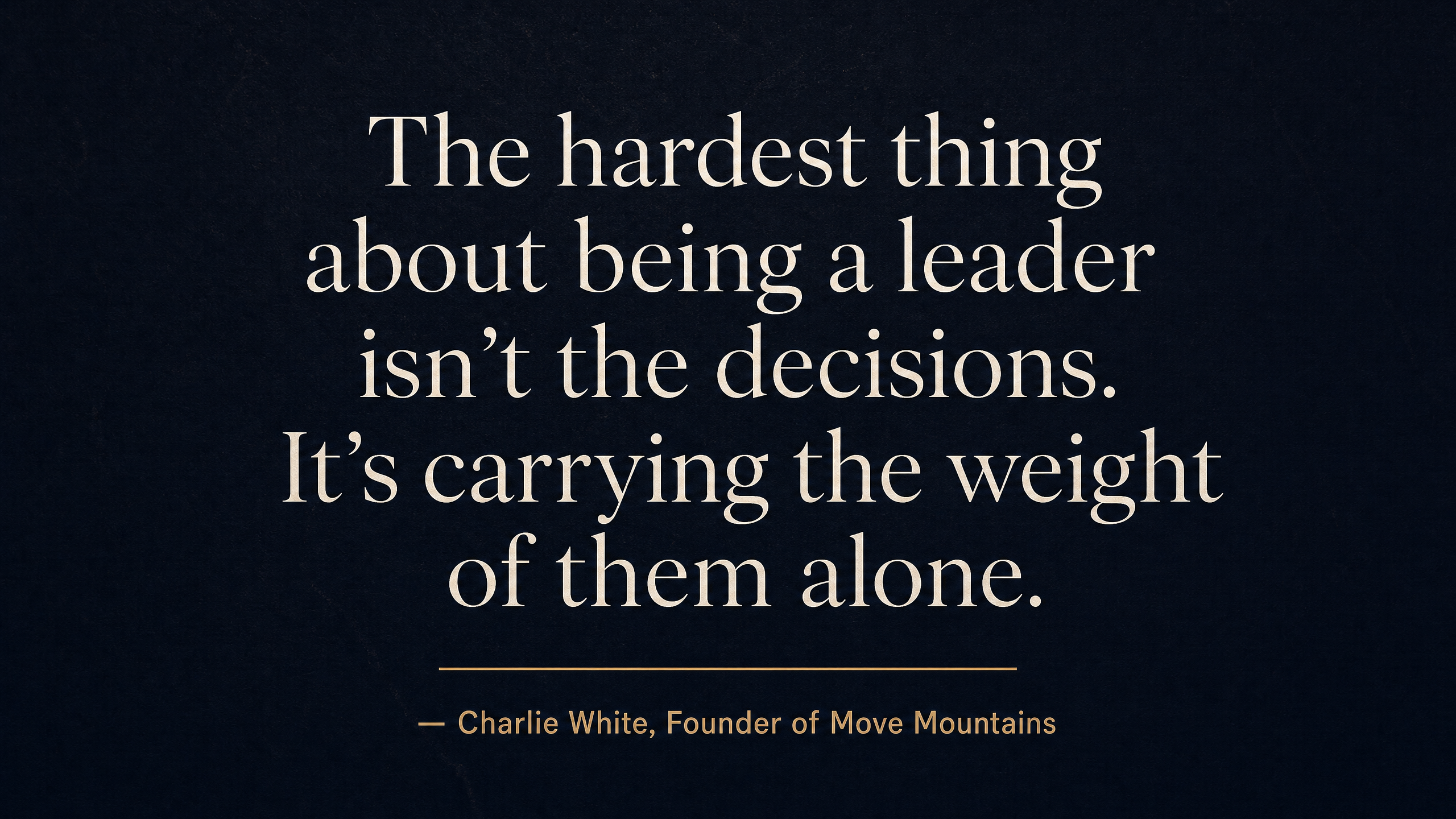
The hardest thing about being a leader isn’t making the difficult decisions. It is the profound, structural loneliness of carrying the weight of those decisions alone.
The Loneliness No One Warns You About
When you step into a senior leadership role, the air gets thinner. You are surrounded by people all day — direct reports, board members, investors, and clients — yet you can feel entirely isolated. This is not the ordinary loneliness of social disconnection. It is a structural isolation built into the role itself.
You cannot process a difficult termination with the team that reports to you. You cannot share strategic doubts with the board that is evaluating your performance. You cannot admit uncertainty to the investors who are counting on your confidence. You are expected to project clarity, even when you are navigating profound ambiguity. And so you perform. Every day. For everyone.
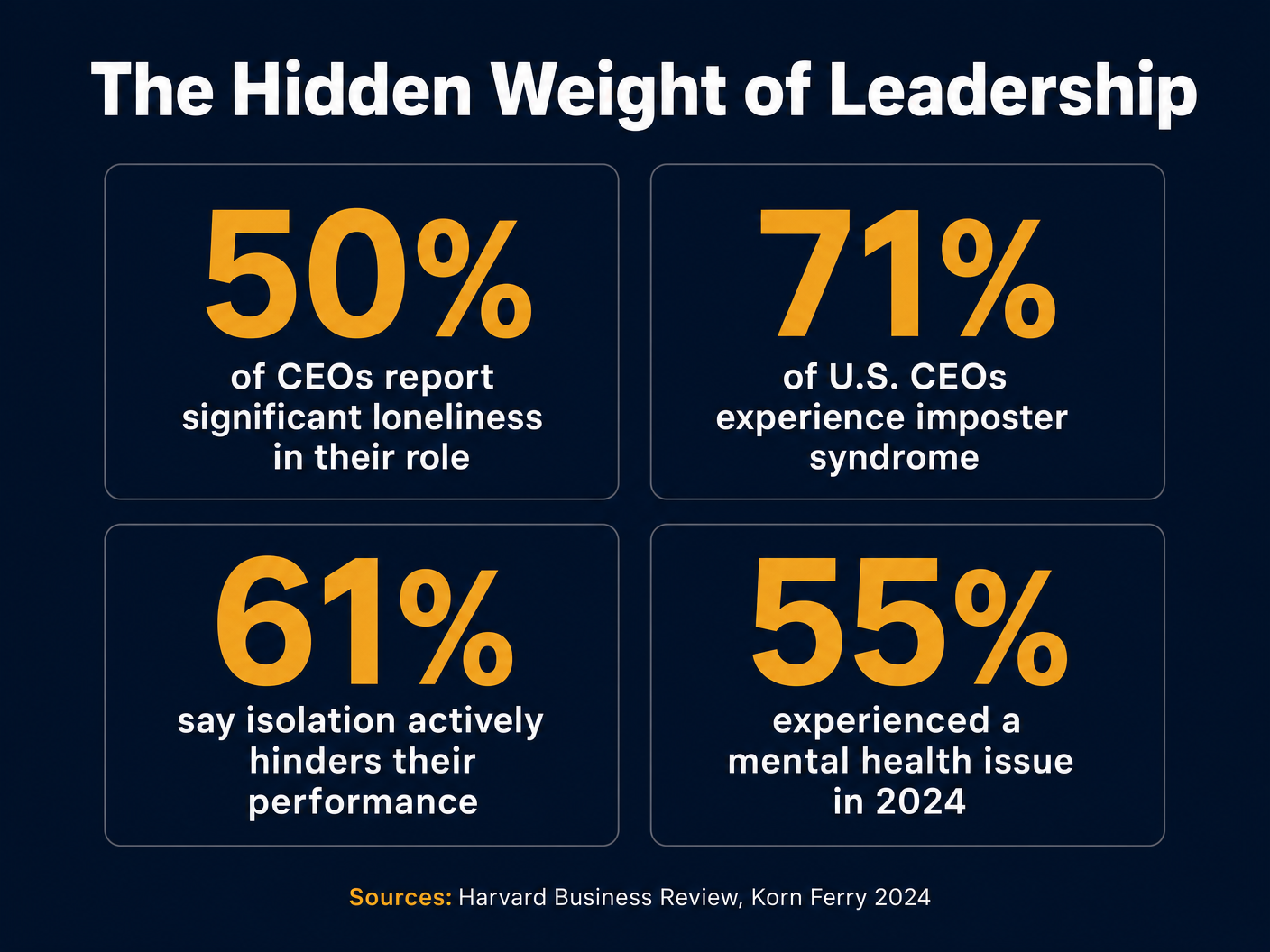
Even more striking: 72% of incoming CEOs report feeling lonelier after taking on new responsibilities, before they have had time to build trusted relationships. The promotion that was supposed to be the culmination of years of effort turns out to be one of the most isolating transitions a person can make.

The structural loneliness of leadership is not about being alone. It is about being surrounded by people and still carrying the hardest things by yourself.
The Feedback Desert
One of the most disorienting transitions leaders describe is the sudden disappearance of honest feedback. For your entire career, you received performance reviews, peer critiques, mentorship, and real-time course corrections. The day you stepped into the top role, that stopped.
People do not tell the leader when they are wrong. Not directly. Not in real time. The power dynamic is too steep, and the political risk is too significant. What the leader receives instead is filtered information — data and perspectives shaped by what people believe the leader wants to hear, or what they believe is safe to say. Over time, this creates what I call a feedback desert: an environment where the person making the highest-stakes decisions has the least access to the unvarnished truth.
“The echo chamber effect develops not because leaders surround themselves with yes-men. It develops because the structure of the role makes honest dissent genuinely difficult for the people around them.”
— Charlie White, Founder of Move MountainsResearch from Harvard Business Review shows that over 70% of incoming CEOs report feeling lonelier after taking on new responsibilities, before they have had time to build trusted relationships. Decisions made without challenge calcify into blind spots. Assumptions go untested. The echo chamber effect does not develop because leaders intentionally surround themselves with people who agree — it develops because the structure of the role makes honest dissent genuinely difficult for the people around them.
The Imposter No One Sees
Most leaders were promoted because they were exceptional at something specific — driving product innovation, managing operations, building client relationships, or executing a financial strategy. They were rewarded for depth of expertise in a domain they had spent years developing. Then they became the leader, and all of that expertise became largely secondary to the demands of the new role.
Leadership requires a fundamental shift: from doing to enabling, from expertise to judgment, from managing a function to holding an entire organization’s direction. It requires making consequential decisions under conditions of incomplete information, where the cost of being wrong is not a missed target but a company-altering crisis.
This gap between what you were trained to do and what you are now required to do breeds a silent epidemic of self-doubt. And the most dangerous part? The higher you rise, the less acceptable it feels to admit it. So the doubt goes underground, where it quietly shapes decisions, erodes confidence, and widens the gap between who you appear to be and who you feel you actually are.

Imposter syndrome in leadership is not about incompetence. It is about the gap between the role you were trained for and the one you are now asked to fill.
The Antidote: Dropping the Mask
At Move Mountains, we see this pattern constantly. Leaders who know better but cannot seem to do better under pressure. Good people burning out — not from the work itself, but from the emotional labor of maintaining the performance of invulnerability. The weight of carrying everyone else’s uncertainty while suppressing their own.
The instinct when feeling isolated or uncertain is to grip the wheel tighter, project more certainty, and build thicker armor. But the actual solution is the exact opposite.
The antidote to leadership isolation is vulnerability. Not the oversharing kind. Not the kind that erodes authority or floods your team with your anxiety. Strategic, intentional vulnerability — the willingness to be honest about process, to acknowledge difficulty, and to invite others into the real conversation rather than the performed one.

Psychological safety begins the moment a leader is willing to say, “I don’t have all the answers” — and mean it.
When a leader is willing to say “I made a mistake” or “I’m not sure yet,” it does not diminish their authority. It humanizes them. It gives the team permission to also be human — to take risks, to surface problems early, and to speak the truth rather than the safe version of it. As Brené Brown puts it: vulnerability is not weakness. It is power.
Knowing what to do differently is the easy part. Here is where to start.
Build a Personal Board of Directors
You need a confidential space where you do not have to perform. Cultivate a small group of peers, mentors, or an executive coach who have no financial or political stake in your company. These are the people who will tell you the truth and allow you to process uncertainty out loud — without it becoming organizational noise.
Actively Solicit Dissent
Stop asking “Does everyone agree?” and start asking “What am I missing?” or “Who sees this differently?” When you reward the people who are brave enough to push back, you dismantle the feedback desert one honest conversation at a time. Make it structurally safe to disagree, and people will.
Practice Strategic Vulnerability
You do not need to overshare to be vulnerable. Strategic vulnerability means being transparent about the process, acknowledging the difficulty of a situation, and admitting when you do not have all the data. It is the difference between saying “Everything is fine” and saying “This is a challenging quarter, but here is how we are navigating it together.” One builds compliance. The other builds trust.
Name the Loneliness — At Least to Yourself
Awareness is the first act of leadership. If you have been feeling the weight of isolation and have been calling it something else — stress, fatigue, burnout — try naming it accurately. Loneliness is not a personal failure. It is a structural feature of the role. When you name it honestly, you can begin to address it intentionally rather than just endure it.
Leadership will always carry weight. The decisions are real, the stakes are high, and the responsibility is significant. That does not change. But the way you carry that weight — alone and armored, or connected and grounded — makes all the difference. Not just for you, but for every person who is watching how you lead.
The body learns what the mind cannot teach. And the experience of leading authentically — without the heavy armor of performed perfection — is a transformation that changes not just the leader, but the entire organization around them.
Work With Move Mountains
Ready to Lead Without the Armor?
We work with leaders who are ready to do the hard part — not just understand differently, but show up differently. Let’s start with a conversation.
Schedule a Discovery CallSources
- Harvard Business Review. “CEO Loneliness and Leadership Struggles.” Research on executive isolation and performance impact.
- Korn Ferry. “71% of U.S. CEOs Experience Imposter Syndrome.” Survey of approximately 400 U.S. executives, June 2024.
- Gallup. “The Power of Leading with Vulnerability.” Research on employee engagement and leader authenticity.
- Gallup. “Why Trust in Leaders Is Faltering and How to Gain It Back.” April 2023.
- Journal of Occupational Health Psychology. Research on clinical depression rates among executives versus general workforce.