The Problem With Optimizing Everything (And How to Find Your Way Back to Joy )

I recently had the pleasure of sitting down with Megan Morris on the Move Mountains Podcast, and our conversation left me both challenged and deeply grateful. Megan, a founder of MOQ Collective, brings a rare blend of humility, lived experience, and real expertise to the health and wellness world. Her consultancy helps brands validate their products through rigorous observational studies and clinical trials, demonstrating her clear value for evidence and rigor. Yet, one of the most profound ideas she shared was this: maybe we don’t need to optimize every single part of our lives to live well.

In a world that constantly pushes us to track, improve, and squeeze more performance out of every hour, Megan’s perspective is a breath of fresh air. It resonates deeply with the work we do at Move Mountains, where we understand that insight alone is insufficient. True progress comes from building the capacity to make grounded, intentional choices, especially when faced with pressure.

The Culture of Constant Improvement: Growth vs. Obsession

There’s nothing inherently wrong with striving for growth. At Move Mountains, growth is at the very heart of our mission. However, it’s crucial to distinguish between genuine growth and an unhealthy obsession with constant self-correction. As Megan candidly pointed out, the wellness world often fixates on absolutes, optimization, and control. We’re surrounded by the rhetoric of biohacking and endless pressure to “optimize,” yet this often leaves us asking a much more fundamental human question: where does joy fit into this relentless pursuit?

This question extends far beyond health. It surfaces in leadership, parenting, our professional lives, and in the subtle ways we judge ourselves for not doing, sleeping, eating, or handling life “better.”
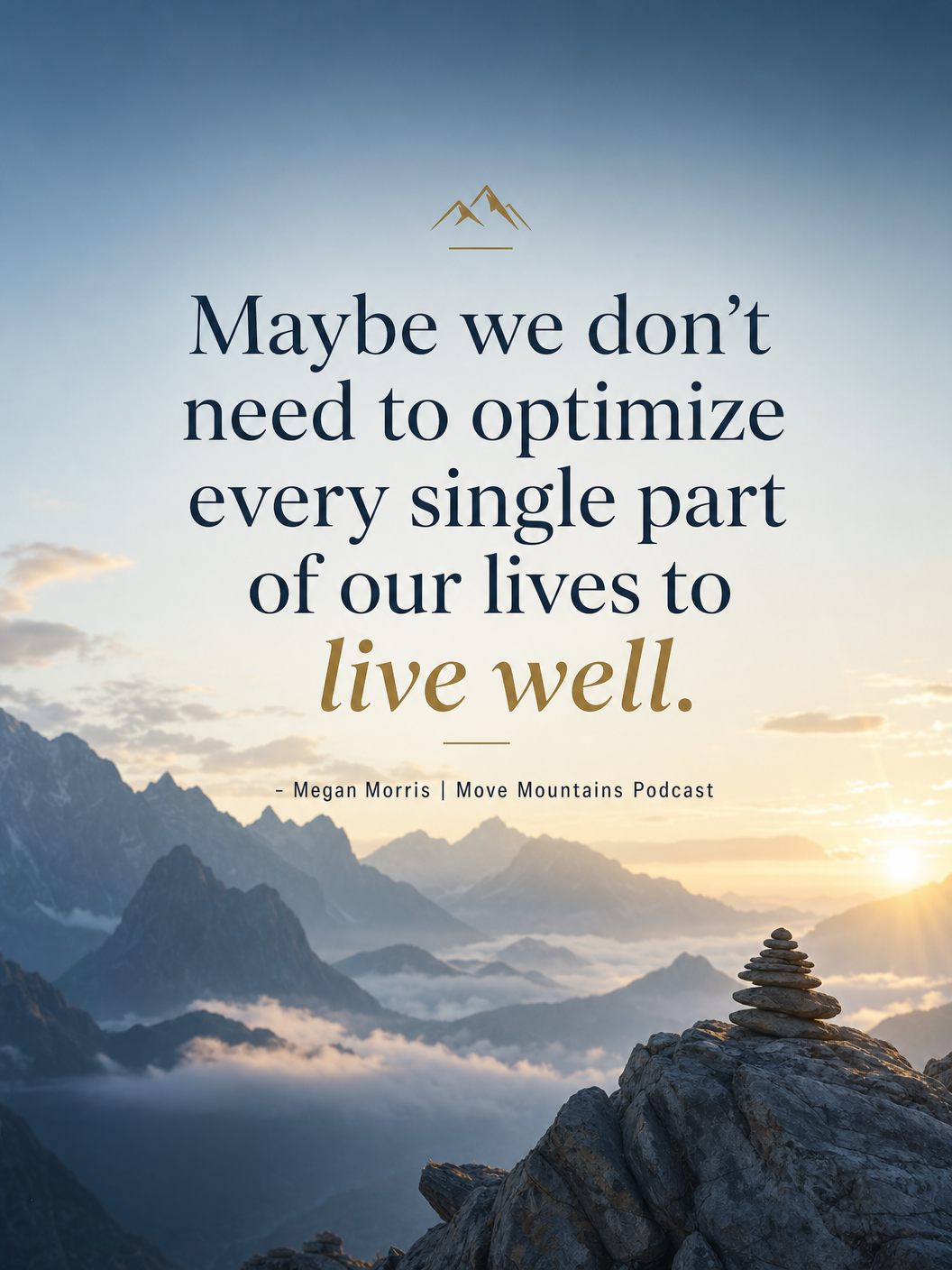
Megan Morris Quote

What Megan Morris Sees Clearly: Tools as Supports, Not Stressors

What I particularly appreciate about Megan’s approach is that she isn’t anti-data, anti-discipline, or anti-performance. Her work at MOQ Collective is a testament to her belief in evidence-based validation. However, she draws a critical distinction: tools and metrics should support our well-being, not become another source of stress.

During our discussion, Megan explained that while wearables can be incredibly helpful for some, for others, they can “add gasoline to stress.” When the numbers on a screen become another set of demands to manage or control, they can inadvertently detract from our overall well-being. This mirrors a pattern we frequently observe in leadership development at Move Mountains. Knowing what to do is fundamentally different from being able to do it. Awareness tools are only beneficial if they expand our choices rather than triggering more reactivity. We call this pivotal moment the Choice Point – the instant where awareness interrupts autopilot and opens the door to a more intentional, grounded response.

The Real Cost of Relentless Optimization: When Even Wellness Drains Us

One of the most memorable insights from our conversation was Megan’s assertion that joy cannot be engineered. This isn’t a dismissal of ambition or health goals, but rather an articulation of a tension many of us feel but struggle to voice. If every aspect of our lives becomes a project to be optimized, even our wellness practices can begin to deplete us. Sleep scores, training metrics, supplements, rigid routines, productivity systems, and even “recovery” can subtly transform from supportive practices into sources of immense pressure. This is especially true when they replace the simple, yet profound, act of genuinely asking ourselves: “How do I actually feel?”

Charlie White Quote

Megan also highlighted another powerful observation: many people have lost touch with their physical baseline. In her experience, individuals often believe they feel “fine” until they experience a significant improvement, only then realizing the extent of their previous depletion. This idea strongly aligns with our philosophy at Move Mountains. We believe that most people don’t primarily need more information; instead, they need the space, awareness, and practice to discern what is truly happening within themselves and to respond with intention, rather than falling back into habitual patterns.

Actionable Takeaways: Finding Your Grounded Path

Here are three practical takeaways from my conversation with Megan that can help you navigate the complexities of modern life with more joy and less pressure. These are simple, but not always easy:

  1. 1. Start with Awareness, Not Optimization: Before you embark on a quest to improve every facet of your life, pause and genuinely ask yourself: How do I actually feelβ€”physically, emotionally, and mentally? This foundational awareness is far more powerful than any optimization strategy.
  2. 2. Make One Sustainable Shift: Megan emphasized the importance of meeting people where they are, rather than overwhelming them with a complete overhaul. This principle applies universally, whether you’re transforming health habits or leadership behaviors. Focus on one small, sustainable change that you can consistently integrate into your life.
  3. 3. Use Tools Wisely: If a wearable device, a specific routine, or a metric genuinely enhances your awareness and helps you feel more grounded, then it’s a valuable tool. However, if it consistently increases anxiety, fixation, or a sense of inadequacy, it might be time to re-evaluate your relationship with that tool and reset your approach.

Megan also shared a highly practical suggestion: keep a simple journal for 30 days. Track a few basic indicators like sleep quality, digestion, energy levels, mood, and general physical sensations. By observing these patterns without judgment, you can gain invaluable insights before jumping to conclusions or implementing drastic changes.
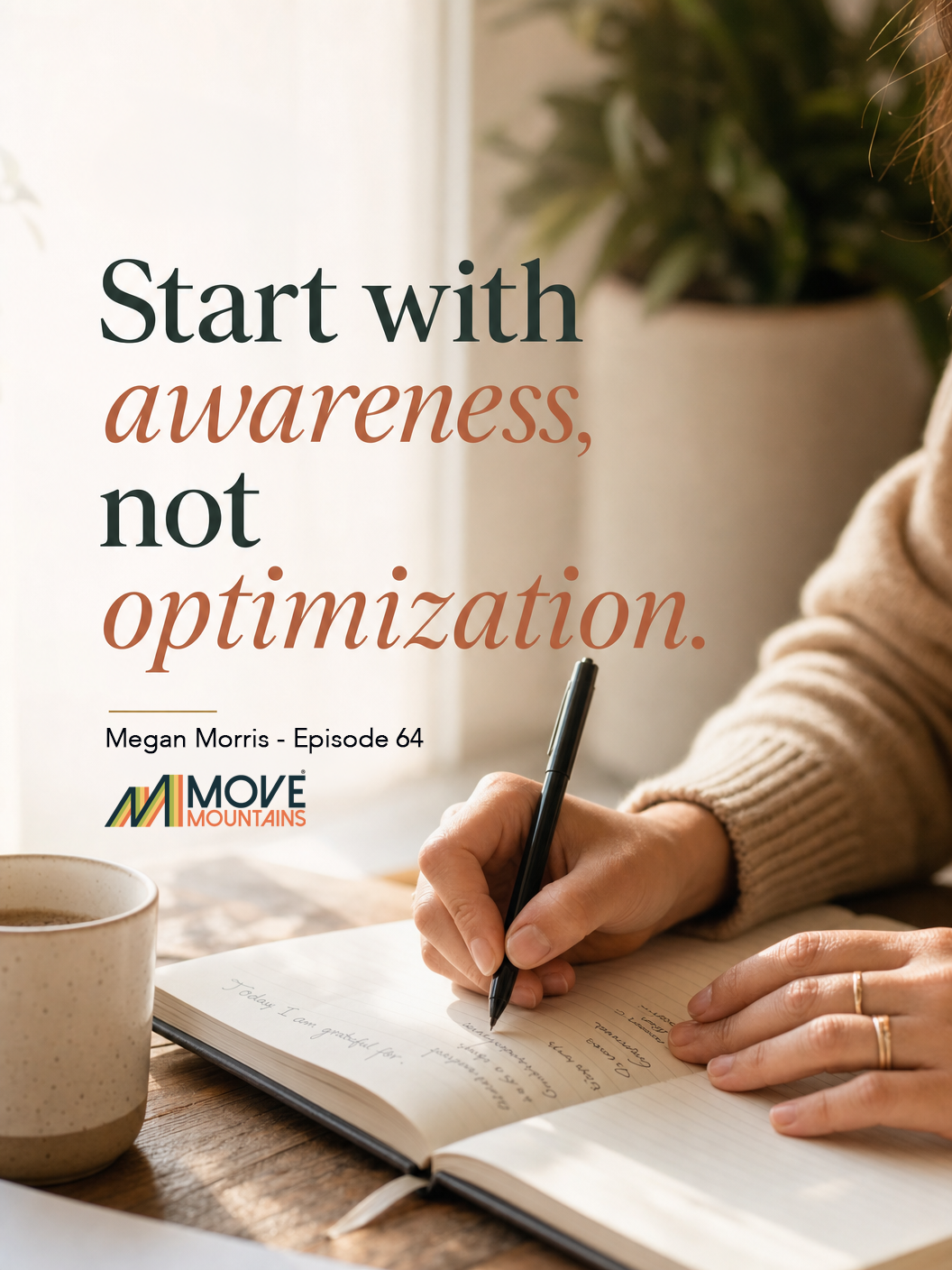
Journaling Quote

Why This Conversation Matters: A Call for Grounded Leadership

I was honored to host Megan on the podcast because she embodies the kind of voice we desperately need in today’s world: thoughtful, evidence-minded, honest, and refreshingly free of performance for performance’s sake. She is engaged in truly meaningful work within a space that yearns for clarity, and she achieves this without ever suggesting that human beings can or should live like machines.

This is precisely why this episode resonated so deeply with me. It wasn’t merely a discussion about wellness products or health trends; it was a profound exploration of how easily we can drift into autopilot, how quickly we lose touch with what truly matters, and the immense importance of returning to a more grounded, intentional way of living and leading.

Listen to the Full Episode

Ready to dive deeper into the conversation? Catch the full podcast episode with Megan Morris and Charlie White on your favorite platform.

Listen Now
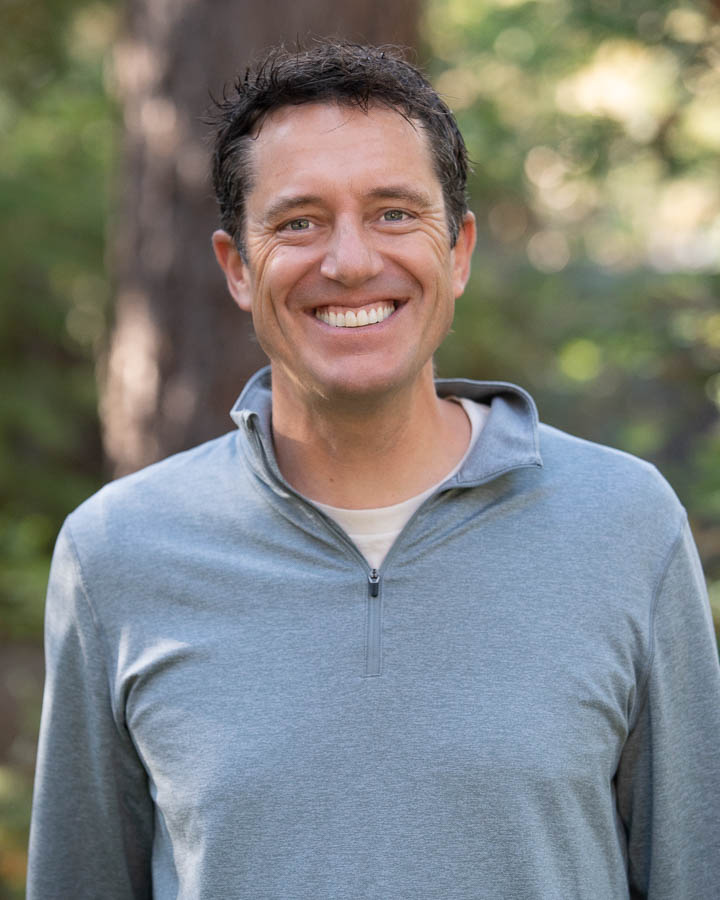

Charlie White Headshot

Charlie White

Charlie White is a co-founder of Move Mountains, where he empowers leaders and teams to navigate complex challenges with clarity and purpose. With a background in education and a passion for intentional growth, Charlie helps individuals and organizations move beyond mere insight to build the capacity for grounded choices and lasting transformation. He believes that true leadership is about fostering environments where people can thrive, not just perform.

Share

What’s the Hardest Thing About Being a Leader That Nobody Talks About? | Move Mountains

When we talk about leadership, we usually talk about strategy. We talk about vision, execution, and driving results. We discuss the mechanics of building teams and the metrics of organizational success.

But there is a quiet reality that exists behind closed office doors and in the spaces between meetings β€” a reality that most leaders experience but rarely discuss, out of fear that acknowledging it might make them look weak, uncertain, or unfit for the role they fought so hard to earn.

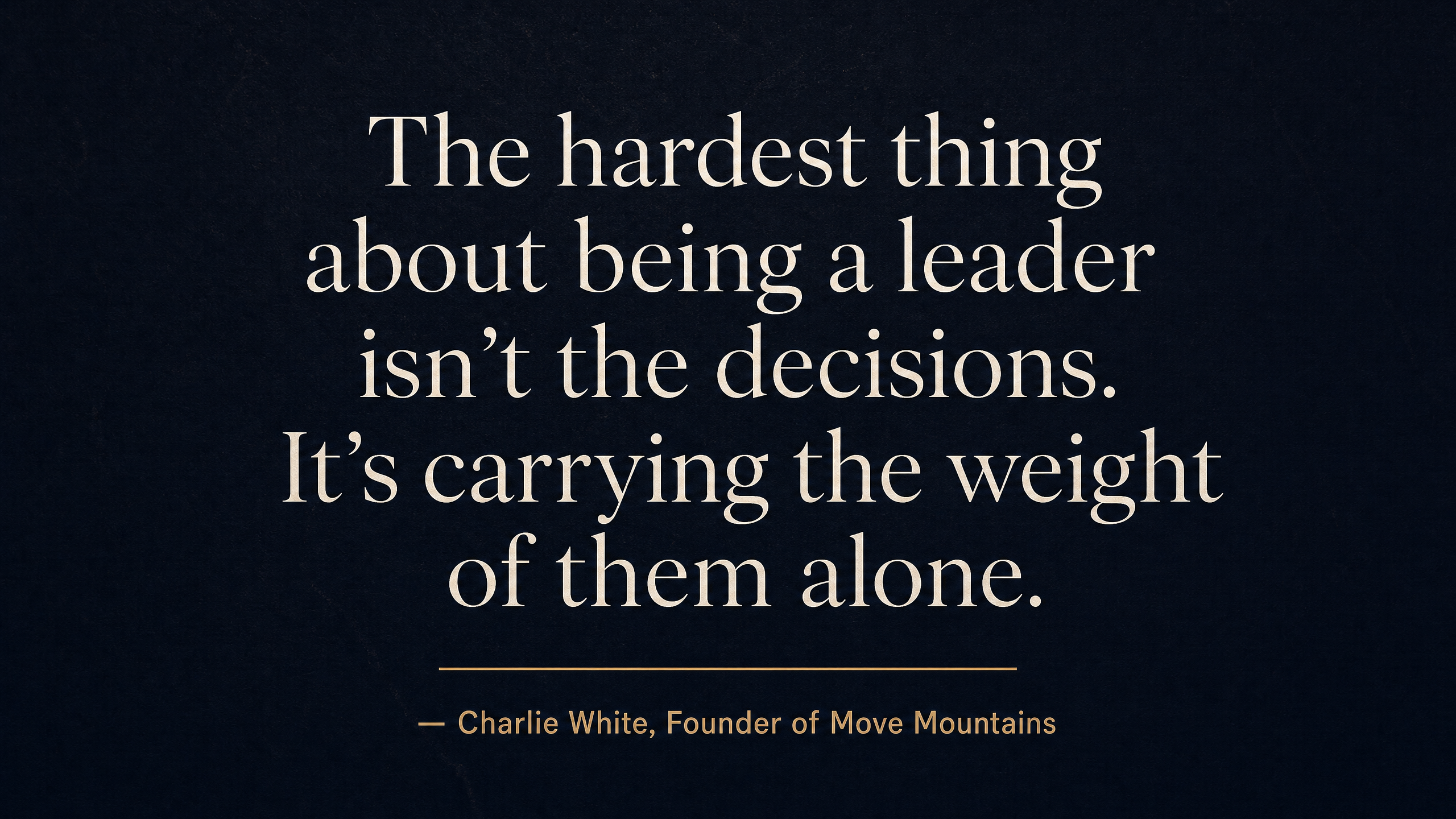
The hardest thing about being a leader isn’t making the difficult decisions. It is the profound, structural loneliness of carrying the weight of those decisions alone.

The Loneliness No One Warns You About

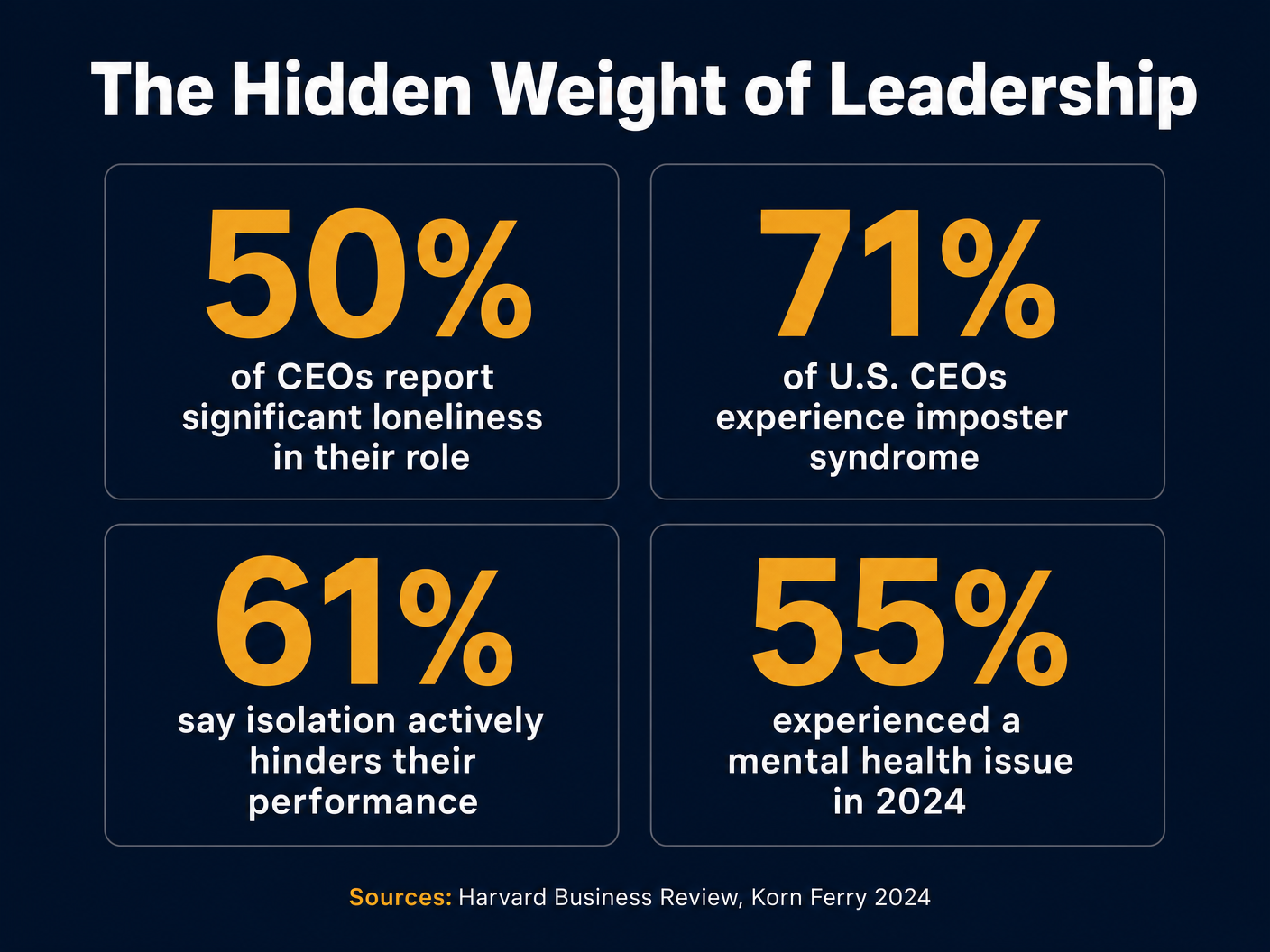
When you step into a senior leadership role, the air gets thinner. You are surrounded by people all day β€” direct reports, board members, investors, and clients β€” yet you can feel entirely isolated. This is not the ordinary loneliness of social disconnection. It is a structural isolation built into the role itself.

You cannot process a difficult termination with the team that reports to you. You cannot share strategic doubts with the board that is evaluating your performance. You cannot admit uncertainty to the investors who are counting on your confidence. You are expected to project clarity, even when you are navigating profound ambiguity. And so you perform. Every day. For everyone.

Even more striking: 72% of incoming CEOs report feeling lonelier after taking on new responsibilities, before they have had time to build trusted relationships. The promotion that was supposed to be the culmination of years of effort turns out to be one of the most isolating transitions a person can make.

A leader sitting alone at the head of a long conference table after a meeting, deep in thought

The structural loneliness of leadership is not about being alone. It is about being surrounded by people and still carrying the hardest things by yourself.

The Feedback Desert

One of the most disorienting transitions leaders describe is the sudden disappearance of honest feedback. For your entire career, you received performance reviews, peer critiques, mentorship, and real-time course corrections. The day you stepped into the top role, that stopped.

People do not tell the leader when they are wrong. Not directly. Not in real time. The power dynamic is too steep, and the political risk is too significant. What the leader receives instead is filtered information β€” data and perspectives shaped by what people believe the leader wants to hear, or what they believe is safe to say. Over time, this creates what I call a feedback desert: an environment where the person making the highest-stakes decisions has the least access to the unvarnished truth.

“The echo chamber effect develops not because leaders surround themselves with yes-men. It develops because the structure of the role makes honest dissent genuinely difficult for the people around them.”

β€” Charlie White, Founder of Move Mountains

Research from Harvard Business Review shows that over 70% of incoming CEOs report feeling lonelier after taking on new responsibilities, before they have had time to build trusted relationships. Decisions made without challenge calcify into blind spots. Assumptions go untested. The echo chamber effect does not develop because leaders intentionally surround themselves with people who agree β€” it develops because the structure of the role makes honest dissent genuinely difficult for the people around them.

The Imposter No One Sees

Most leaders were promoted because they were exceptional at something specific β€” driving product innovation, managing operations, building client relationships, or executing a financial strategy. They were rewarded for depth of expertise in a domain they had spent years developing. Then they became the leader, and all of that expertise became largely secondary to the demands of the new role.

Leadership requires a fundamental shift: from doing to enabling, from expertise to judgment, from managing a function to holding an entire organization’s direction. It requires making consequential decisions under conditions of incomplete information, where the cost of being wrong is not a missed target but a company-altering crisis.

This gap between what you were trained to do and what you are now required to do breeds a silent epidemic of self-doubt. And the most dangerous part? The higher you rise, the less acceptable it feels to admit it. So the doubt goes underground, where it quietly shapes decisions, erodes confidence, and widens the gap between who you appear to be and who you feel you actually are.

A leader standing in front of a mirror in a modern office, the reflection conveying the duality of public confidence versus private self-doubt

Imposter syndrome in leadership is not about incompetence. It is about the gap between the role you were trained for and the one you are now asked to fill.

The Antidote: Dropping the Mask

At Move Mountains, we see this pattern constantly. Leaders who know better but cannot seem to do better under pressure. Good people burning out β€” not from the work itself, but from the emotional labor of maintaining the performance of invulnerability. The weight of carrying everyone else’s uncertainty while suppressing their own.

The instinct when feeling isolated or uncertain is to grip the wheel tighter, project more certainty, and build thicker armor. But the actual solution is the exact opposite.

The antidote to leadership isolation is vulnerability. Not the oversharing kind. Not the kind that erodes authority or floods your team with your anxiety. Strategic, intentional vulnerability β€” the willingness to be honest about process, to acknowledge difficulty, and to invite others into the real conversation rather than the performed one.

Two professionals engaged in an open, honest conversation in a sunlit modern office, conveying trust and psychological safety

Psychological safety begins the moment a leader is willing to say, “I don’t have all the answers” β€” and mean it.

When a leader is willing to say “I made a mistake” or “I’m not sure yet,” it does not diminish their authority. It humanizes them. It gives the team permission to also be human β€” to take risks, to surface problems early, and to speak the truth rather than the safe version of it. As BrenΓ© Brown puts it: vulnerability is not weakness. It is power.

Pull quote: The hardest thing about being a leader isn't the decisions. It's carrying the weight of them alone. β€” Charlie White, Founder of Move Mountains
Actionable Takeaways

Knowing what to do differently is the easy part. Here is where to start.

1

Build a Personal Board of Directors

You need a confidential space where you do not have to perform. Cultivate a small group of peers, mentors, or an executive coach who have no financial or political stake in your company. These are the people who will tell you the truth and allow you to process uncertainty out loud β€” without it becoming organizational noise.

2

Actively Solicit Dissent

Stop asking “Does everyone agree?” and start asking “What am I missing?” or “Who sees this differently?” When you reward the people who are brave enough to push back, you dismantle the feedback desert one honest conversation at a time. Make it structurally safe to disagree, and people will.

3

Practice Strategic Vulnerability

You do not need to overshare to be vulnerable. Strategic vulnerability means being transparent about the process, acknowledging the difficulty of a situation, and admitting when you do not have all the data. It is the difference between saying “Everything is fine” and saying “This is a challenging quarter, but here is how we are navigating it together.” One builds compliance. The other builds trust.

4

Name the Loneliness β€” At Least to Yourself

Awareness is the first act of leadership. If you have been feeling the weight of isolation and have been calling it something else β€” stress, fatigue, burnout β€” try naming it accurately. Loneliness is not a personal failure. It is a structural feature of the role. When you name it honestly, you can begin to address it intentionally rather than just endure it.


Leadership will always carry weight. The decisions are real, the stakes are high, and the responsibility is significant. That does not change. But the way you carry that weight β€” alone and armored, or connected and grounded β€” makes all the difference. Not just for you, but for every person who is watching how you lead.

The body learns what the mind cannot teach. And the experience of leading authentically β€” without the heavy armor of performed perfection β€” is a transformation that changes not just the leader, but the entire organization around them.

Work With Move Mountains

Ready to Lead Without the Armor?

We work with leaders who are ready to do the hard part β€” not just understand differently, but show up differently. Let’s start with a conversation.

Schedule a Discovery Call
Charlie White
Founder, Move Mountains

Charlie White is the founder of Move Mountains, a leadership development firm based in Incline Village, Nevada, that works with leaders, teams, and organizations to install real, lasting behavior change. Through coaching, training, adventure experiences, and speaking, Move Mountains helps leaders access their best β€” especially when it matters most.

Sources

  1. Harvard Business Review. “CEO Loneliness and Leadership Struggles.” Research on executive isolation and performance impact.
  2. Korn Ferry. “71% of U.S. CEOs Experience Imposter Syndrome.” Survey of approximately 400 U.S. executives, June 2024.
  3. Gallup. “The Power of Leading with Vulnerability.” Research on employee engagement and leader authenticity.
  4. Gallup. “Why Trust in Leaders Is Faltering and How to Gain It Back.” April 2023.
  5. Journal of Occupational Health Psychology. Research on clinical depression rates among executives versus general workforce.

Share

What separates great leaders from average ones isn’t intelligence, credentials, or experience. It’s the standard they set and the culture they build around it.

I sat down recently with Dr. John Holmes, COO of STAX Engineering and a retired U.S. Coast Guard Captain with over 40 years of maritime leadership experience. The conversation pushed on a few things I needed to look at in my own practice.

Dr. John Holmes COO STAX Engineering retired U.S. Coast Guard Captain

Who Is Dr. John Holmes?

John isn’t a typical COO. Before leading operations at STAX β€” a company whose mobile technology captures and controls ship emissions without modifying the vessel β€” he spent decades commanding U.S. Coast Guard units in demanding operational environments.

Now he applies those same principles to a fast-scaling company that’s an approved provider of on-call emissions control services for vessels at the Port of Los Angeles.

40+ Years
Of maritime leadership experience brought into private-sector operations

Active barges, volatile port schedules, regulatory complexity, a young and diverse workforce β€” STAX is a real-time leadership laboratory. Sitting across from John, you can feel the experience behind every answer.

The “Good Enough” Trap

One of the moments that stuck with me was John talking about his own early years. He coasted through high school and the first half of college on “good enough” effort, then finished his last two years with a 4.0 once he understood what full commitment actually meant.

“Good enough just isn’t. You can’t dial it in.”

I want to be careful with this one, because it’s not about perfectionism or never feeling like you’re enough. There’s a difference between beating yourself up and showing up with your full capacity, whatever that looks like on a given day.

What John is pointing at is intentionality. When leaders and teams settle for 70%, they don’t just underperform β€” they erode the culture around them without realizing it.

A simple question for any leader: are your standards explicit? Do your people actually know what “great” looks like on your team?

Alignment Over Agreement

The most useful insight from John’s career, for me, was this: in the military, once you walk out of the room, everyone pulls in the same direction β€” whether they agreed inside it or not.

In the civilian world, he found the opposite. Decisions get relitigated. People lobby for do-overs. Energy bleeds out through the hallways.

“You can make a bad decision work if everybody’s pulling in the same direction. But if you’re not pulling together, you can’t even make a good decision work.”

That landed for me. The breakdown is rarely the strategy. It’s the lack of unified commitment to executing it.

I see this constantly. Leaders spend enormous energy crafting the right plan, then watch it fail β€” not because the plan was wrong, but because two or three people half-delivered their piece.

What John and I landed on is straightforward: debate hard before the decision, commit fully after, evaluate at a defined checkpoint, then adjust. Agility and alignment work in sequence, not opposition.

Servant Leadership in Practice

John is direct about the philosophy underneath his leadership: servant leadership. Not the version on office walls β€” the actual practice of having your people’s backs, taking the hit when something goes wrong, and building people up so they can carry more.

He said something worth repeating: people don’t care what you know until they know that you care. At STAX, that shows up in real ways β€” flexibility when life demands it, ownership in the mission, and expectations that communicate belief instead of pressure.

This is the difference between team development and team building. Topgolf every quarter is fine. But it doesn’t build the trust and shared accountability that hold a team together when something hard happens.

Leadership team alignment trust and servant leadership in practice

What You Can Use

Here’s what I’d take from the conversation:

  • Audit your decision culture. Honest debate before the decision. Full commitment after. A defined review window so people trust that committed doesn’t mean permanent.
  • Hire for fit, not just credentials. Look for people who’ll work with the company, not just for it.
  • Set high expectations as an act of belief. Excellence communicates trust when it’s paired with support.
  • Give people equity in the outcome. Literal or cultural β€” people perform differently when they have ownership.
  • Know the difference between team building and team development. Social connection builds rapport. Intentional growth builds performance.
  • Model “I was wrong.” Leaders who own mistakes create teams willing to take risks, tell the truth, and learn fast.

Before the Decision

Invite honest debate, challenge assumptions, and surface concerns while the door is still open.

After the Decision

Require unified execution. Alignment matters more than lingering private disagreement.

At the Checkpoint

Review outcomes together, learn quickly, and adjust without blame.

The Bottom Line

Conversations like this are why I do this work. The principles forged in some of the most demanding leadership environments β€” the open ocean, search and rescue, national security β€” translate directly to a boardroom, a startup, a scaling company.

The thread running through everything John shared is the same thread we work with at Move Mountains. Set the standard. Align the team. Serve the people in front of you. Refuse to settle for good enough.

That’s how leaders move people forward.

Ready to build a leadership culture that actually moves people forward?

Dr. John Holmes was a recent guest on the Move Mountains Podcast. Listen wherever you get your podcasts. If you’re working on alignment, accountability, or culture inside your organization, reach out.

Connect With Move Mountains

About the Author

Charlie White is a leadership coach and facilitator with Move Mountains, where he helps leaders and teams grow through mindful leadership, experiential learning, and intentional team development. His work centers on helping organizations build healthier cultures, stronger relationships, and more aligned execution.

Sources:

STAX Engineering team page: https://www.staxengineering.com/our-team/

STAX Engineering Port of Los Angeles announcement: https://www.staxengineering.com/stax-hub/stax-pola-contract-release/

Move Mountains Charlie White bio: https://www.movemountains.com/about-us/our-team/charlie-white

Share